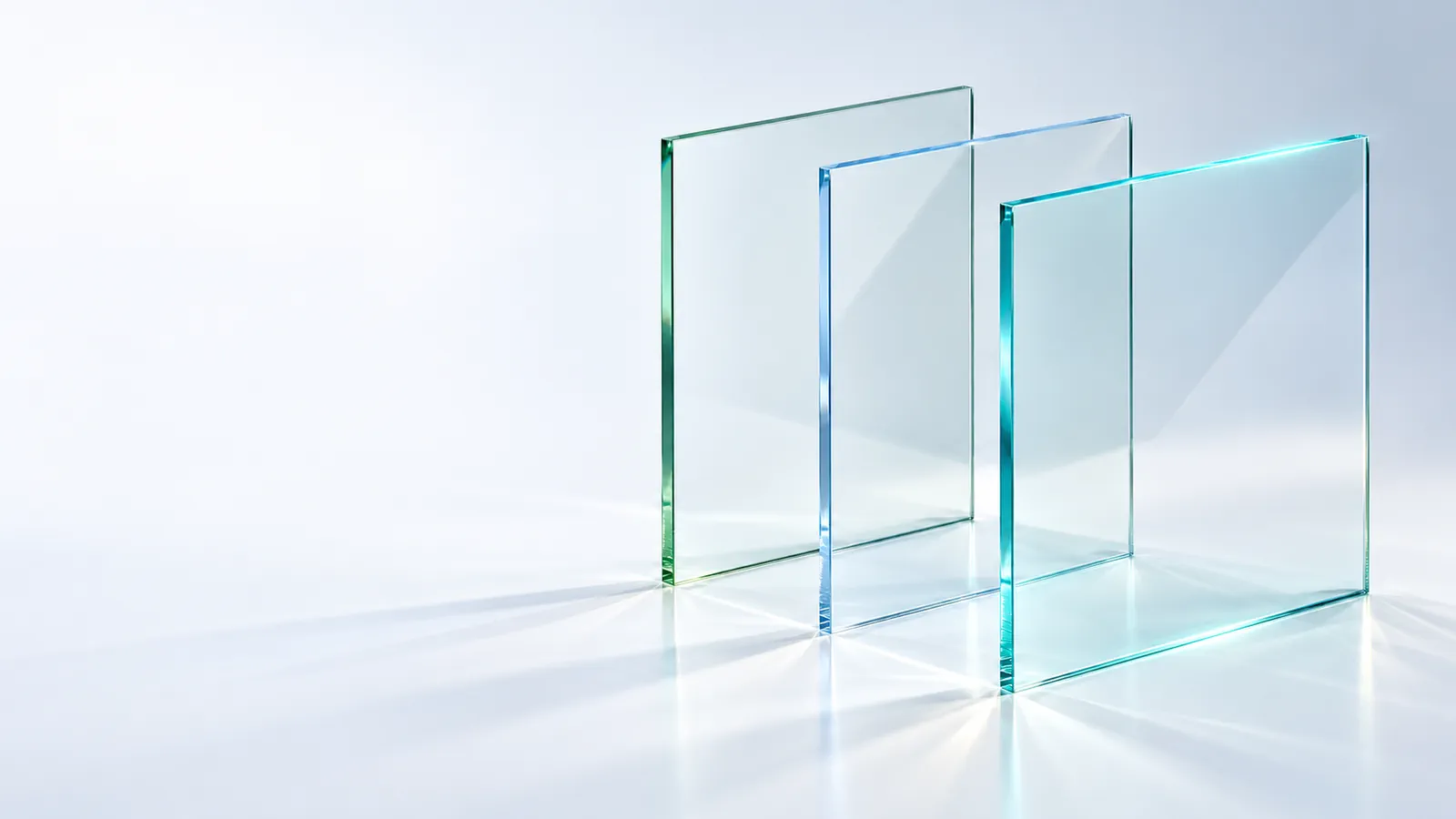
Two clear glass sheets can look almost identical yet differ in colour rendering, light scattering and electrical conduction. For ordinary glazing those differences mainly affect appearance. For electrochromic, heated and anti-condensation glass they also affect how the finished product works.
To make sense of the labels, keep three ideas apart: the quality grade of the glass substrate, its optical tint, and the properties of the functional coating. Grade M1, the word “low-iron”, and the name TEC answer different questions.
At Octoglass we work only with quality M1 glass and quality TEC. We use M1 as the starting float sheet for every type of glass product we make. We usually apply TEC in electrochromic, heated and anti-fog constructions. We back material selection with document checks and measured characteristics.
What glass grades M1, M2, M3 and others mean
People often say “sort”, but the standard talks about a glass grade. It describes allowed optical distortion, defects and other regulated properties of the starting sheet.
The year of the document matters. The older GOST 111-2001 listed M0, M1, M2, M3, M4, M5, M6 and M7. GOST 111-2014 provides M0, M1, M4 and M7. So a claim of “M2 to GOST 111-2014” needs clarification from the supplier: which document and which requirements does the label refer to?
The practical point of a grade is to limit defects that spoil the view through the glass or get in the way of further processing. When comparing grades you look at defect size and count, the character of distortion, and the tolerances. The more demanding the optical task, the more carefully those requirements must be matched to the real sheet.
M1 is a quality substrate for further processing — not a promise of a perfectly defect-free material. Allowed defects are assessed under set rules. The grade also does not replace requirements for tempering, laminating, coating or the finished product.
A useful way to read the current grades:
- M0 — tighter limits on defects than M1. Some requirements, including optical distortion, are the same for M0 and M1.
- M1 — regulated optical distortion and defect limits; a quality base for further processing.
- M4 — allows more non-destructive defects; optical-distortion requirements differ from M0 and M1.
- M7 — optical distortion and the number of non-destructive defects are not regulated by the corresponding tables. That does not cancel the standard’s other requirements.
Why M1 is the best fit for our products
M0 has stricter defect limits, but that advantage has to be weighed against finished part size and the cutting layout. In our practice a substantial premium for M0 pays off mainly for large-format parts where you need a clean working area across the whole piece and almost no room to cut around a defect. Even then, grade M0 does not guarantee a sheet free of every flaw: each sheet still needs inspection.
Octoglass does not usually take on such large-format jobs. For our products we choose quality M1. If the starting sheet has defects, they are caught in early glass-processing steps: flawed areas are rejected and not used in finished parts.
M0 costs substantially more, and with our part sizes and early rejection that premium is usually not justified. Quality M1 is therefore the quality–cost optimum for Octoglass work. We judge a given sheet by its fitness for the future part — not only by the label on the stock.
Standard clear glass and low-iron glass
Ordinary clear float glass can show a noticeable greenish tint, especially at the edge, in thick sheets and in laminated stacks. That tint comes mainly from iron in the composition. “Clear” in the product name does not mean a complete absence of colour.
Low-iron (extra-clear) glass is made from raw materials with reduced iron content. It usually looks more neutral and absorbs less visible light. Pilkington Optiwhite, for example, is a low-iron float that transmits light well and adds little colour of its own. The difference is clearest at the edge and in thick laminated constructions.
The market also uses the word “decolorized”. For selection it is better to ask what that means in practice: low iron, defined optical values, or only marketing language. Comparing the product datasheet, thickness and samples under the same conditions is more reliable.
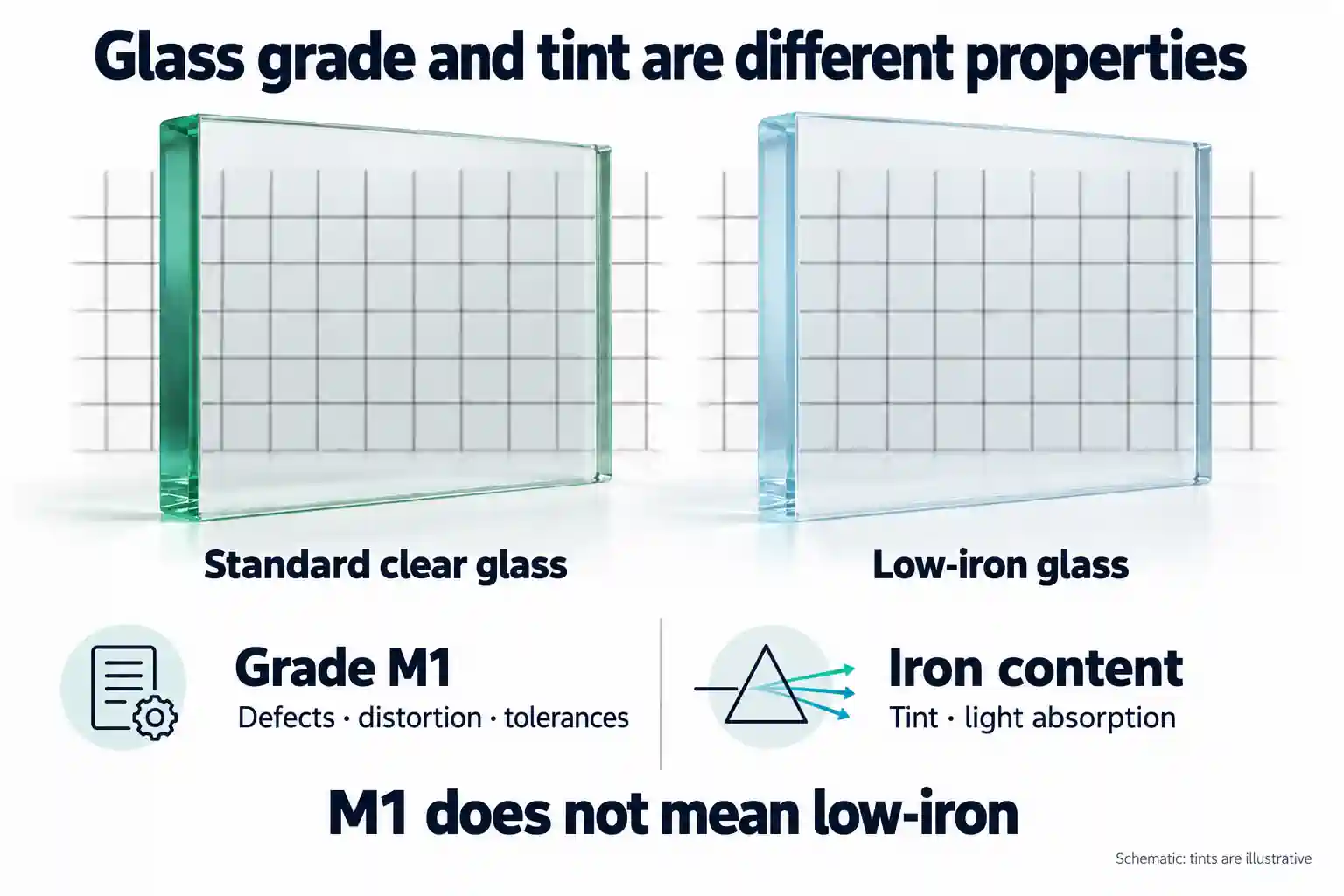
M1 and low-iron are not synonyms. The first label is about sheet quality under a standard; the second is about composition and optics. Low-iron glass can still have defects; ordinary quality M1 can still show a green edge.
For thick laminated glass, display windows, white decorative surfaces and colour-critical work, substrate neutrality matters a lot. But low-iron alone does not make glass tempered, impact-resistant, conductive or electrochromic. Those properties come from other parts of the construction.
What FTO is and why clear glass can carry current
FTO is fluorine-doped tin oxide, SnO₂:F. It is one of the TCO materials — transparent conducting oxides. A thin coating combines visible-light transmission with electrical conductivity. In such a construction current flows mainly in the coating, not through the thickness of the glass substrate.
FTO is used as a transparent electrode and as a heating layer. It is important to separate the coating material from the trade name of the finished glass: TEC is a product family, K Glass is a brand, and Planibel is a large AGC product group. They do not mean one universal material with identical parameters.
These materials have concrete jobs. For example, Pilkington/NSG recommends TEC 15 for passive condensation-risk reduction and thermal insulation: a low-emissivity coating helps cut radiative heat loss while the glass stays fairly neutral in appearance. In a suitable refrigerated display construction that helps keep the room-side surface warmer. “Passive” means the effect comes without powering the coating; it does not guarantee zero condensation under every condition.
TEC 35, 50, 70 and 250 are offered for electrically heated glass — for example in refrigerator doors where fogging and icing must be controlled. TEC 8 is aimed in particular at amorphous-silicon thin-film solar cells: higher scattering helps keep light in the active structure. In electrochromic glass a TEC conducting layer acts as the transparent electrode that drives the change in light transmission. The exact grade is chosen for the device design.
How FTO is formed on glass: online CVD
Picture a continuous hot glass ribbon moving along a float line. It is not yet cold warehouse stock, yet a functional coating is already forming on its surface. In industrial online CVD the layer is created during glass manufacture itself. CVD stands for Chemical Vapour Deposition.
Gas-delivery units sit above the hot ribbon. A reagent mixture with the precursors for the future coating is brought to the surface. Heat from the glass drives the chemistry: a thin tin-oxide layer forms, and fluorine doping changes its electrical properties. Gaseous by-products are removed. This is not a stuck-on film or a paint layer: the coating grows on the glass through a chemical reaction.
The ribbon then cools and anneals before being cut into sheets. The result is glass with a pyrolytic coating firmly bonded to the surface — hence “hard” coatings. Line speed, reagent mix and feed, temperature and layer stack set the balance of conductivity, light transmission and scattering. Depending on the product, the stack may also include helper layers, for example a barrier against sodium migration from the glass.
Visually the surface stays clear, while the functional layer can already carry current and change heat transfer. Coating durability suits industrial processing, but allowed tempering, bending, washing and laminating regimes are still defined per product.
A conductive coating is not finished smart glass. An electrochromic product still needs a working electrochromic system, electrical contacts, sealing and control. Heating needs calculated contacts, power and a thermal regime.
TEC, K Glass and Planibel: what differs
NSG TEC: a family for different electrical and optical jobs
NSG TEC covers products with different sheet resistances, light transmission and haze. The manufacturer lists electrochromic devices, heating, refrigeration and thin-film photovoltaics among applications.
Even within TEC you cannot choose glass by the number in the name alone. You need the full designation, thickness, variant and datasheet. A clear example is TEC 7 versus TEC 7 Low Haze: in a published NSG summary they share the same nominal resistance but differ in light scattering.
K Glass: primarily low-emissivity glazing
Classic Pilkington K Glass is known as glass with a hard pyrolytic low-emissivity coating. Its main job is to reduce radiative heat exchange in glazing. Classic K Glass is described with a conductive FTO coating, but a similar coating chemistry does not make it automatically interchangeable with a chosen TEC.
K Glass and TEC are technologically close, but their requirements follow the intended use. For K Glass bought as energy-saving glass, low emissivity and optics come first. For TEC chosen as a transparent electrode or heater, electrical performance is critical as well.
On a K Glass delivery, sheet-resistance uniformity across the area may not be specified in as much detail as for a TEC selected for an electrical job. Glass that is fine for thermal insulation can then show uneven resistance and fail as a specific heater or electrode. A single measurement or an average will not reveal that.
That does not mean every K Glass is uneven or every TEC is perfectly uniform. You need an exact specification and multi-point measurements. Coating non-uniformity can affect current distribution and heating, and in an electrochromic build — voltage distribution and device behaviour. Chemical similarity alone does not make K Glass and TEC drop-in replacements.
Planibel: the full name matters
Calling any Planibel “FTO-coated glass” is incorrect. For a fair comparison you need specific pyrolytic products, such as Planibel G, G fasT and A — not the whole family at once.
AGC describes Planibel G as glass with a pyrolytic Low-E coating, suitable among other uses for heated glazing and commercial refrigeration. G fasT adds surface treatment for scratch resistance and easier processing.
So the correct comparison is: a specific TEC against a specific K Glass or Planibel on the parameters that matter. A brand name is not a specification.
FTO versus Low-E deposited by PVD
Low-E means low emissivity — a coating property — while FTO is a coating material. Treating them as two incompatible glass types is wrong: FTO can also be low-emissivity. In practice the usual comparison is hard pyrolytic FTO versus a multilayer Low-E stack made by PVD. For more on Low-E in glazing, see our article on climate-control and low-emissivity glass.
PVD is Physical Vapour Deposition. Architectural Low-E widely uses magnetron sputtering in vacuum. A finished glass sheet travels through a multi-chamber tool. Plasma ions knock material from targets; that material deposits on the glass as successive thin layers.
A typical high-performance PVD Low-E stack contains one or more ultra-thin silver layers plus dielectric, protective and other helper layers. The stack works as a whole: silver largely sets heat-reflecting behaviour, while the other layers tune optics, protection and process compatibility.
| What we compare | Pyrolytic FTO, online CVD | Typical silver-containing Low-E, PVD |
|---|---|---|
| When it is applied | On the hot ribbon during glass manufacture | On a finished sheet in a separate vacuum coater |
| How the layer forms | Chemical reaction of gaseous reagents at the surface | Deposition of material sputtered from targets |
| Main structure | Conductive fluorine-doped tin oxide; helper layers possible | Multilayer stack with silver, dielectrics and protective layers |
| Strength | Durable conductive coating suited to many electrode and heating jobs | Precise spectral tuning and very low emissivity possible |
| Handling the coating | Usually high durability; process windows depend on the product | Many grades need protection inside an IGU or laminated build |
| Fitness as electrode or heater | Set by the chosen grade and specification | Does not follow automatically from silver or low emissivity; separate verification is required |
Silver-containing PVD Low-E can deliver lower emissivity and a more flexible mix of light transmission and solar control than ordinary pyrolytic coatings. For an electrochromic device or heater you also need electrical contact to the working layer, resistance distribution, chemical compatibility and durability through every production step.
A silver conducting layer buried in a multilayer stack is not the same as a contactable transparent-electrode surface. There are also dedicated PVD coatings for heating: the deposition method alone does not lock a material to one function. Choice follows the design and verified performance.
Sheet resistance and haze: examples from documentation
Below are manufacturer reference figures, not Octoglass product ratings. The first table reproduces selected values from one published NSG summary for solar applications. They must not be applied to every regional version or similarly named delivery.
| Product from NSG summary | Thickness, mm | Light transmission, % | Sheet resistance, Ω/sq | Haze, % |
|---|---|---|---|---|
| TEC 7 | 2.1–4.0 | 80–82 | 7 | 4.0–6.0 |
| TEC 7 Low Haze | 2.1–4.0 | 81–83 | 7 | 1.5–2.0 |
| TEC 8 | 2.1–4.0 | 79–81 | 8 | 9–11 |
| TEC 10 | 2.1–4.0 | 82–83 | 10 | 0.7 |
| TEC 15 | 1.6–6.0 | 82–84 | 13 | 0.5 |
These are reference values for the listed grades; they are not universal guaranteed limits for the whole range.
AGC publishes the following figures for a 4 mm sheet before tempering:
| AGC product | Light transmission, % | Sheet resistance, maximum, Ω/sq | Haze, maximum, % |
|---|---|---|---|
| Planibel A | 80 | 11 | 0.7 |
| Planibel G | 83 | 17 | 0.5 |
| Planibel G fasT | 83 | 17 | 0.5 |
| Pure Comfort 10 | 81 | 11 | 0.8 |
| Pure Comfort 14 | 83 | 14 | 0.7 |
Resistance and haze here are maximum values; light transmission has tolerances set in the manufacturer’s documentation.
The tables show why materials cannot be ranked simply as “better” or “worse”. Higher scattering can help trap light in some solar cells, yet be unwanted in glazing that needs a sharp view.
Heating grades also include much higher resistances. In one published Pilkington table TEC 35 is listed at 32–48 Ω/sq, TEC 70 at 58–72 Ω/sq and TEC 250 at 260–325 Ω/sq. That illustrates range diversity — not a rule for decoding product names.
Catalogues, markets and grades can differ. Compare like with like: thickness, measurement method, condition before or after heat treatment, and whether the figure is typical, minimum or maximum.
What Ω/sq means — and why lower is not always better
Sheet resistance Rₛ, also called surface resistance of the coating, is measured in ohms per square: Ω/□, Ω/sq. It characterises a thin conductive layer. It is not the resistance of the whole glass product and not a “per square metre” value.
For a uniform rectangular coating with continuous contacts on two opposite edges:
R = Rₛ × L / W,
where L is the distance between contacts along the current path and W is the width of the conducting area across the current. The formula ignores contact resistance, coating non-uniformity and complex shapes.
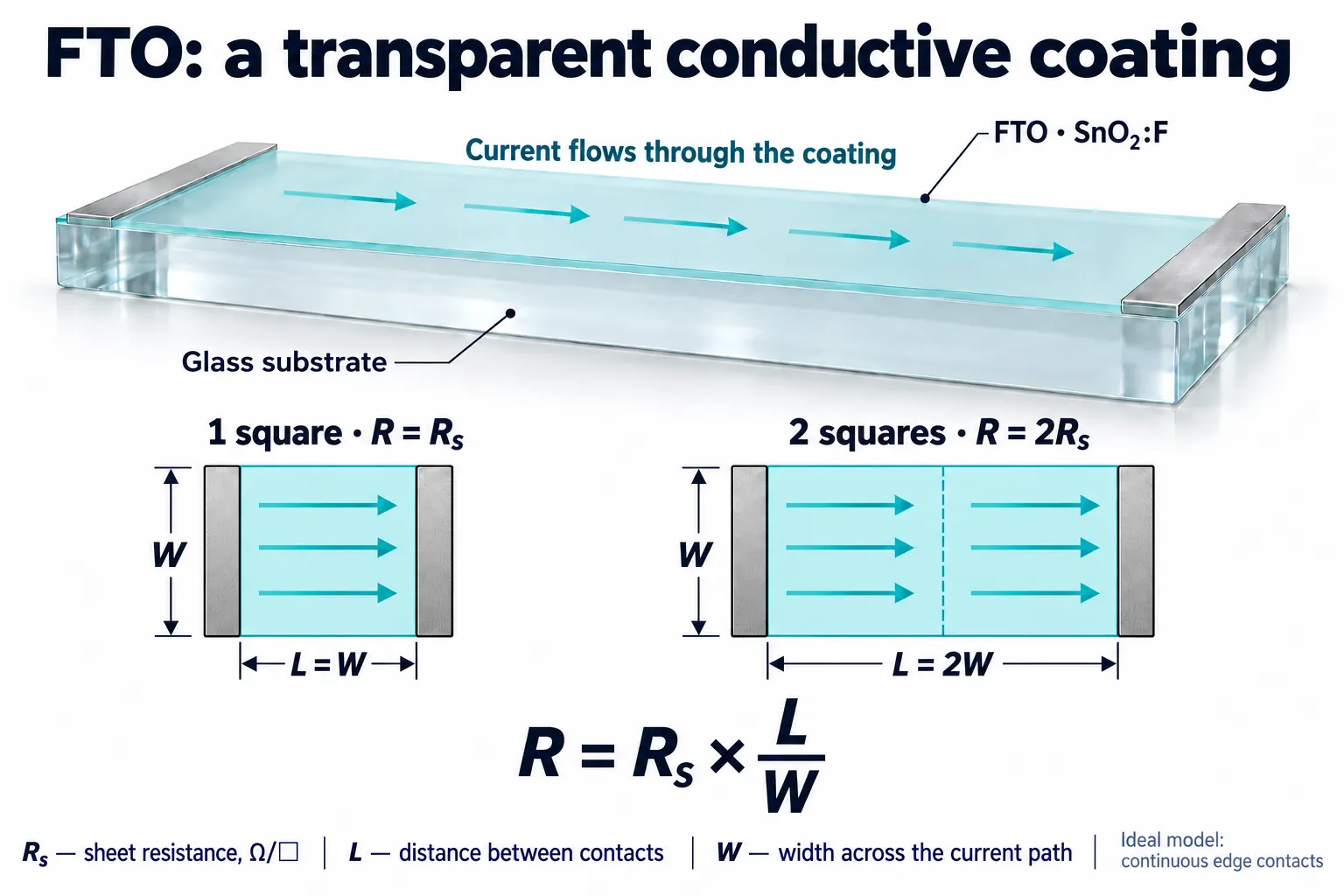
For example, at Rₛ = 10 Ω/sq an ideal square gives 10 Ω, while a rectangle with L/W = 2 gives 20 Ω. At the same shape and voltage, lower resistance means higher current and higher heating power: P = U²/R. So “most conductive” is not “most suitable”: the material is chosen for supply, size, contacts and required temperature.
For electrochromic glass, electrode resistance affects voltage distribution across the area. Switching speed and uniformity also depend on the electrochromic system itself, contact design, product size and control algorithm. You cannot promise identical behaviour for different constructions from an Ω/sq figure alone.
Light transmission, haze and colour: three different metrics
Light transmission is the share of incident light that passes through the sample under defined measurement conditions. Full and directional transmittance must be distinguished: instruments with different collection geometry for scattered light can disagree.
Haze is the share of transmitted light scattered outside an angle set by the method. Fair comparison needs the same method and geometry. High total transmission can still come with a visible haze: plenty of light gets through, but image contrast falls.
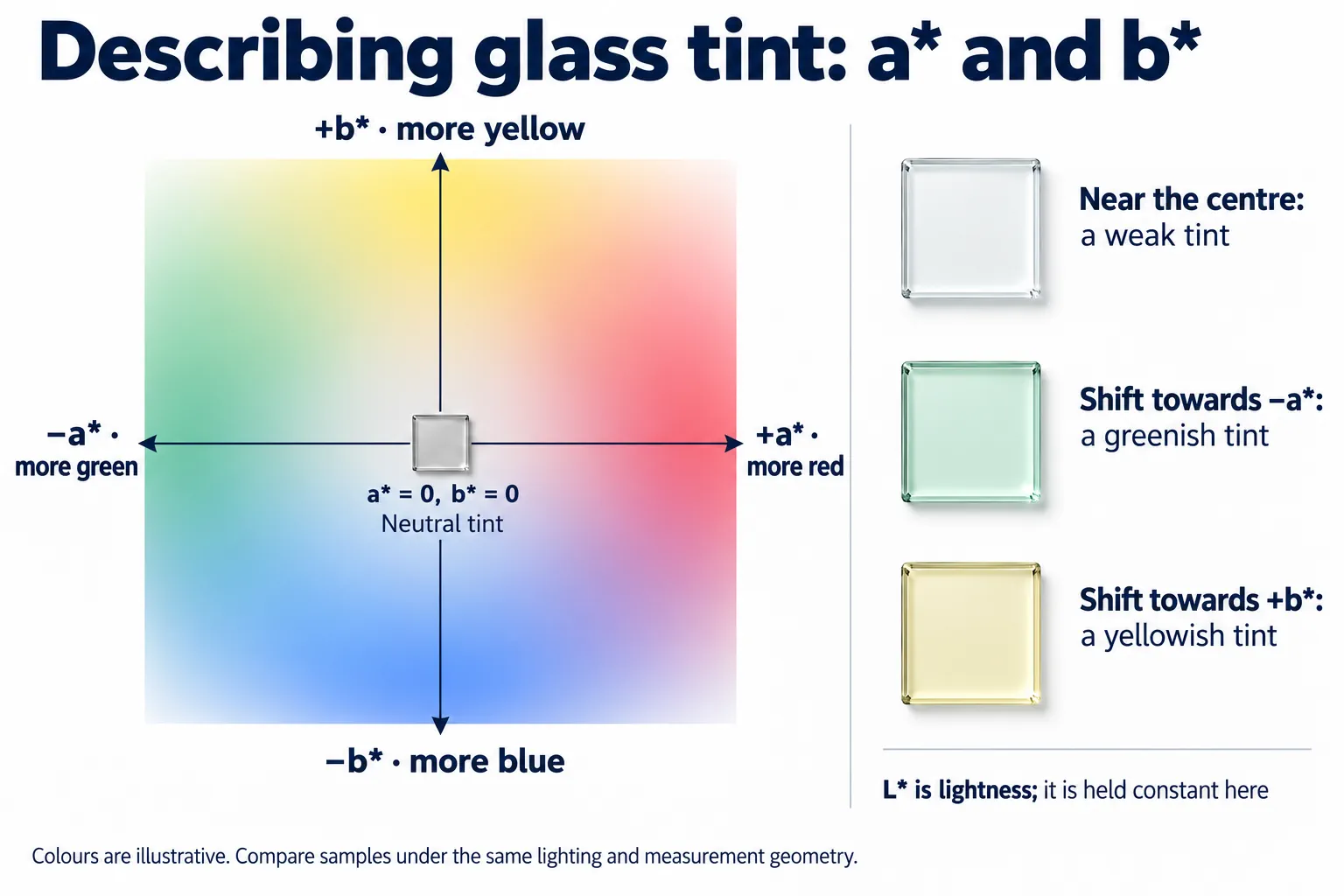
Colour describes the inherent tint of the glass and coating. CIELAB coordinates are often used: a* is the green–red axis, b* the blue–yellow axis, and L* is lightness. Comparison needs the same illuminant, viewing conditions and measurement mode — for example transmittance or reflectance.
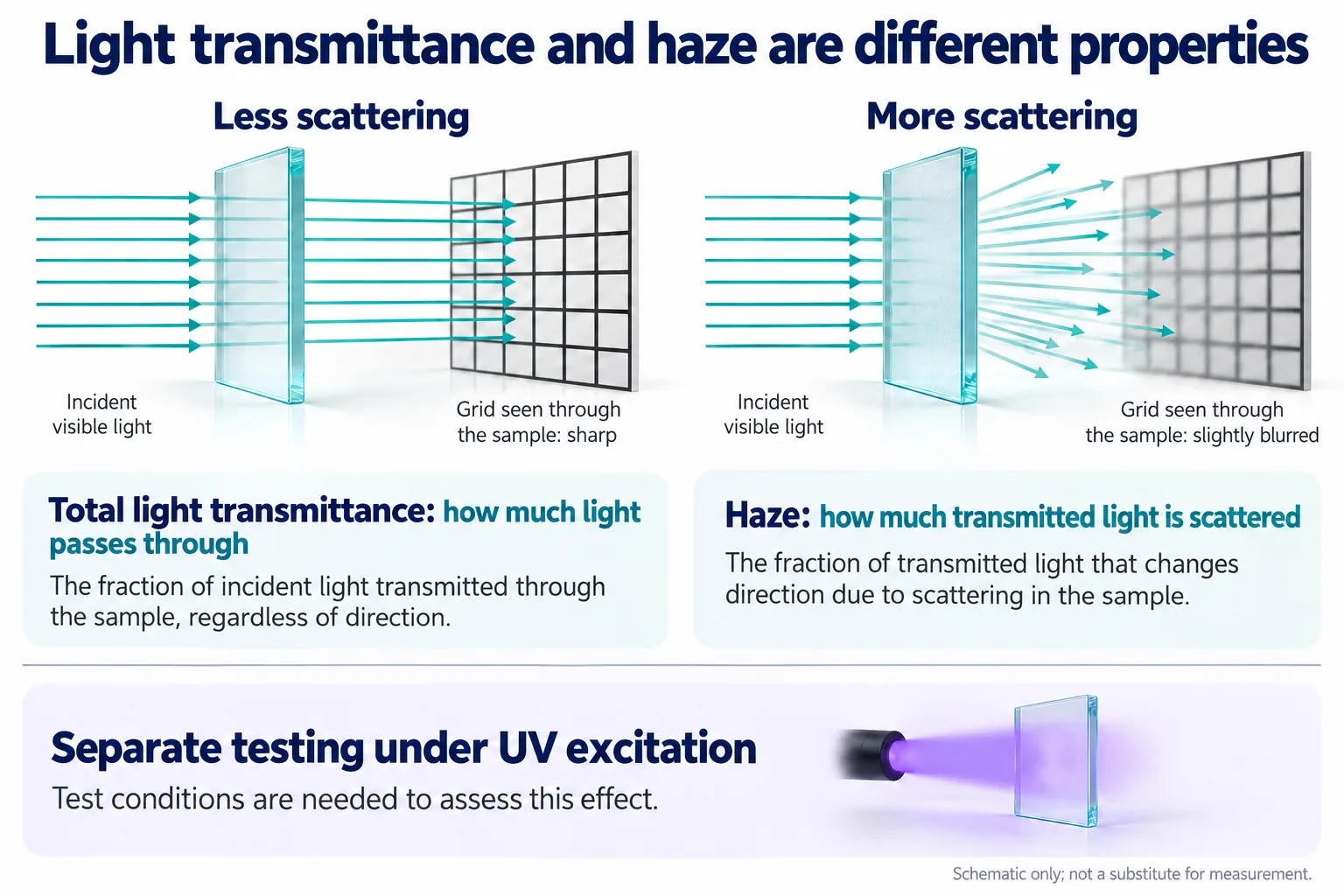
A similar-looking “haze” can have different causes: coating scatter, soiling, surface damage or extra optical effects under excitation. A UV-excitation assessment must not be treated automatically as a standard haze measurement. Scatter and luminescence have different mechanisms; finding the cause needs test conditions and, if needed, further study.
How to read a* and b*
Remember the directions: negative a* is greener, positive a* redder; negative b* is bluer, positive b* yellower. At the same lightness L* and other conditions, a point closer to the centre of the a*–b* plane means a weaker tint. A neutral colour alone does not say how much light passes through the glass.
How Russian and foreign standards relate
Standards set requirements and test methods. They are not a ranking of producing countries. Good glass is chosen by verified characteristics; origin alone does not replace batch control.
Russia: GOST 111-2014
GOST 111-2014 covers starting clear flat glass. On the official Rosstandart portal it is listed as current; the introduction date in Russia is 1 April 2016. It is a basis for assessing the starting sheet, not a universal standard for every finished glass product.
Belarus: shared interstate base
Belarus took part in adopting GOST 111-2014. A published accreditation scope from Belarus’s Technical Institute for Certification and Testing lists the transition for flat glass from GOST 111-2001 to GOST 111-2014 from 1 October 2016.
If a Belarusian producer claims M1 to the same GOST 111-2014, that is one interstate classification — not a separate “Belarusian M1 analogue”. For a delivery and a specific product you still check the edition in force, amendments and national requirements. A historical transition date alone does not prove today’s batch compliance.
Kazakhstan: GOST 111-2014 is also used
GOST 111-2014 appears in Kazakhstani regulatory documents for construction materials. So when glass is supplied to that GOST you compare the same grade and requirements — you do not translate a “Kazakhstani sort” into a Russian one.
A national ST RK system does not mean every glass gets a separate national grade instead of M1. What matters is the document stated on the product passport.
United States: ASTM C1036
Starting flat glass uses ASTM C1036. ASTM lists C1036-25 as the current edition. Clear-glass classification includes Q1–Q4 categories linked to quality requirements and intended use, including mirrors, architectural processing and general glazing.
You cannot set “M1 = Q1” or “M1 = Q3” from class names alone. You must compare allowed defects, their distribution, distortion, size, thickness, inspection conditions and test methods. Matching application areas does not prove full equivalence.
China: GB 11614-2022
China’s GB 11614-2022 “Flat glass” has been in force since 1 August 2023 and replaced GB 11614-2009. The new edition has two appearance-quality categories: 普通级 — ordinary grade and 优质加工级 — high-quality processing grade (descriptive translations). The older three-step classification must not be presented as the new one without explanation.
An example of differences: for 4 mm clear glass the Chinese document sets a minimum visible light transmission of 87%, while GOST 111-2014 sets 88% for glass with standard transmission. That compares one regulated figure — not overall product quality from two countries.
Europe: substrate and coating separately
For the float substrate the EN 572 series matters; for coated glass, EN 1096. AGC, for example, states Planibel substrate compliance with EN 572-1 and EN 572-2, and listed pyrolytic coatings as class A to EN 1096-1. Coating class A is not an equivalent of substrate grade M1.
GOST 111-2014 also notes non-equivalent correspondence to EN 572-8:2012 — NEQ. That is another reason not to treat the standards as fully interchangeable.
How Octoglass checks glass quality
For our products both raw-material documents and measured properties matter. At Octoglass we work only with quality M1 and quality TEC, and we judge fitness for the product’s intended use.
Our control includes:
- Batch document checks. We confirm origin, product designation and claimed characteristics.
- Defect inspection. We check the glass and surface for defects that affect appearance and further processing.
- Coating resistance measurement with a stratometer. We control the electrical parameter that matters for conductive electrodes and heating.
- Haze measurement on an in-house instrument. Besides visible-range assessment we study the effect under UV excitation, which in our practice we call UV-induced opalescence. We treat it separately from ordinary haze.
- Light-transmission measurement with calibrated taumeters. We check actual light passage through the sample.
- Control of colour coordinates
a*andb*. We assess tint that a single transmission figure cannot describe. - Elemental analysis in doubtful cases. If composition is in question, we send samples for further study.
That approach helps select feedstock by measurable properties and product requirements. Even similarly named materials can behave differently after processing or in a laminated construction.
What to clarify when choosing glass
For the starting sheet you need grade, standard with edition year, thickness, allowed defects and tint requirements. If colour neutrality matters, agree separately on ordinary or low-iron substrate.
For conductive glass also clarify the full coating name, resistance and its tolerances, haze, light transmission, colour and allowed processing regimes. For the finished product assess the whole construction: one sheet’s figures do not automatically describe a laminated stack, IGU or electrochromic system.
Octoglass specialists can help select the substrate and coating for your task. Tell us where the glass will work, what sizes, clarity and functions you need — electrochromic tinting, heating or anti-fog protection. Contact Octoglass.
Updated 21 October 2026. Reference figures apply to the stated grades and conditions; order parameters are set by the specification of the specific product and construction.